
8 Best Call Center CRM Software (2026)
TL;DR
Compare the 8 best call center CRM software platforms of 2026 across six CRM types, 11 feature criteria, and evaluation dimensions including data integration openness, AI maturity, and total cost of ownership for contact center deployments.
8 Best Call Center CRM Software (2026)
Source: AmplifAI BOFU Guide Purpose: Comprehensive buyer's guide comparing top call center CRM software vendors Last Updated: March 2026
Call center CRM software in 2026 spans everything from full-suite platforms managing sales, service, and marketing under one roof to lightweight, service-first tools built exclusively for support ticket management, and every vendor in the category now claims AI-native intelligence regardless of how deeply that capability actually runs.
Selecting the right call center CRM software for your contact center requires more than comparing feature checklists, because the CRM market has shifted from a question of "which platform manages your customer data" to "which platform lets you act on that data across every team that touches the customer." Sales leaders need pipeline visibility, service teams need case resolution workflows, and QA and coaching teams need access to the same interaction data to drive agent performance, yet most CRM platforms treat these needs as separate products or gated add-ons.
Generative AI has accelerated this problem, with CRM vendors racing to embed AI-powered insights, sales coaching, and predictive analytics into their platforms while simultaneously restricting how freely that data flows to other AI-native systems, creating a scenario where your most valuable customer and sales data lives behind walls that prevent the rest of your contact center from acting on it.
In this guide we break down the 8 best call center CRM software platforms of 2026, the types of CRM software buyers need to distinguish between, the features that define the category, and the evaluation criteria your team should use to select the right platform for your contact center.
Compare Call Center CRM Software: 2026 Rankings
Compare the best call center CRM software of 2026 with 8 vendors ranked across six CRM types, evaluating each platform on its core customer management capabilities, AI and predictive intelligence, sales enablement features, and data integration openness to adjacent contact center systems.
Click any vendor name to jump to their detailed evaluation below.
| Rank | CRM Software | Overview |
|---|---|---|
| 1 | Salesforce Service Cloud | Salesforce Service Cloud CRM software delivers full-suite sales, service, and marketing capabilities through a unified data model with Einstein AI powering predictive analytics and conversational intelligence across every channel. |
| 2 | HubSpot Service Hub | HubSpot Service Hub CRM software combines sales, marketing, and service hubs in a unified interface with open API architecture and fast time-to-value deployment for mid-market contact centers. |
| 3 | Zendesk | Zendesk CRM software delivers service-first customer support through ticketing, help desk, and AI-powered automation across email, chat, phone, social, and messaging channels. |
| 4 | Microsoft Dynamics 365 | Microsoft Dynamics 365 CRM software provides full-suite sales and service capabilities with deep integration into Teams, Outlook, Power BI, and Azure AI for enterprise contact centers. |
| 5 | Freshworks | Freshworks CRM software delivers service ticketing through Freshdesk and sales pipeline management through Freshsales with Freddy AI automation at accessible mid-market pricing. |
| 6 | Zoho CRM | Zoho CRM software provides full-suite sales, service, and marketing automation through an ecosystem of 50+ native applications with Zia AI analytics at cost-effective pricing tiers. |
| 7 | Oracle CX | Oracle CX CRM software combines sales, service, and marketing automation with deep ERP, supply chain, and financial management integration for large-scale enterprise contact center deployments. |
| 8 | SAP Service Cloud | SAP Service Cloud CRM software delivers customer service and sales capabilities integrated with S/4HANA, supply chain management, and financial systems for global enterprise contact centers. |
| Review Methodology: The 8 best call center CRM software vendors are evaluated according to core CRM functionality, AI maturity, data integration openness, sales enablement capabilities, and total cost of ownership for contact center deployments. | ||
What is Call Center CRM Software
Call center CRM software manages customer relationships, tracks sales and service interactions, and enables contact center teams to segment, engage, and communicate with customers through unified profiles and automated workflows.
Call center CRM software falls into six distinct categories:
- Full-Suite CRM: End-to-end customer relationship management spanning sales, service, and marketing in a single platform with shared data across all three functions.
- Service-First CRM: Platforms built primarily for customer support and service operations, with CRM capabilities layered around ticketing, case management, and help desk workflows.
- Sales-First CRM: CRM platforms optimized for pipeline management, deal tracking, and sales enablement, with service modules available as secondary add-ons.
- Enterprise CRM: Large-scale platforms designed for complex, multi-business-unit deployments with deep ERP, back-office, and supply chain integration.
- Industry-Specific CRM: CRM solutions tailored to vertical-specific workflows and compliance requirements for industries like healthcare, financial services, and insurance contact centers.
- AI-Native CRM: CRM platforms built with artificial intelligence at the core, delivering predictive analytics, automated engagement, and intelligent routing as foundational capabilities rather than bolt-on features.
Types of Call Center CRM Software
Call center CRM software buyers face a fundamental challenge: vendors across all six types market themselves as "CRM software," making it difficult to compare platforms that serve fundamentally different purposes. A service-first ticketing platform and a full-suite CRM managing sales, service, and marketing pipelines both claim the CRM label, but they solve different problems for different teams at different price points.
Understanding which type of call center CRM software your contact center actually needs prevents costly misalignment, where a sales team buys a service-first tool expecting pipeline management, or a support team deploys an enterprise CRM designed for back-office integration when a focused help desk platform delivers faster time to value.
Call center CRM software types also determine how freely your customer and sales data flows to adjacent systems like performance management, QA, and coaching platforms, and that data portability distinction matters more in 2026 than feature parity between vendors.
The table below categorizes each type by what it does and which vendors operate in that space.
| CRM Software Type | What It Does | Vendors |
|---|---|---|
| Full-Suite CRM | End-to-end customer relationship management spanning sales, service, and marketing in a single platform with shared data across all three functions. | Salesforce Service Cloud, Microsoft Dynamics 365, Zoho CRM |
| Service-First CRM | Platforms built primarily for customer support and service operations, with CRM capabilities layered around ticketing, case management, and help desk workflows. | Zendesk, Freshworks |
| Sales-First CRM | CRM platforms optimized for pipeline management, deal tracking, and sales enablement, with service modules available as secondary add-ons. | HubSpot Service Hub |
| Enterprise CRM | Large-scale platforms designed for complex, multi-business-unit deployments with deep ERP, back-office, and supply chain integration. | Oracle CX, SAP Service Cloud, Microsoft Dynamics 365 |
| Industry-Specific CRM | CRM solutions tailored to vertical-specific workflows and compliance requirements for industries like healthcare, financial services, and insurance contact centers. | Salesforce Service Cloud, Microsoft Dynamics 365, Oracle CX |
| AI-Native CRM | CRM platforms built with artificial intelligence at the core, delivering predictive analytics, automated engagement, and intelligent routing as foundational capabilities. | Salesforce Service Cloud, HubSpot Service Hub, Freshworks |
| Strategic Guidance: This Market Taxonomy segments call center CRM software by primary function and deployment model. Not all call center CRM software is created equal; contact center leaders and sales managers need to distinguish between full-suite platforms, service-first tools, sales-first CRM, and enterprise-grade deployments. The distinction that matters most is whether your CRM type enables or restricts data flow to the adjacent performance management, QA, and coaching platforms your contact center depends on. | ||
The Hidden Cost of Gated Call Center CRM Software Data
Call center CRM software captures some of the most valuable data in your contact center, including customer interaction history, sales pipeline activity, service case outcomes, and sentiment signals across every channel, yet the growing trend among CRM vendors to gate and restrict access to that data creates a cost most buyers don't calculate until after deployment.
CRM data gating shows up in three ways that directly impact your contact center's ability to act on the information your CRM collects.
Restricted API access and premium integration tiers force contact centers to pay additional licensing fees to move customer and sales data into adjacent platforms like performance management, QA, and coaching tools. Your CRM captures the interaction, but the insights from that interaction stay locked behind an integration paywall, disconnected from the supervisors and QA teams who need to act on them.
Proprietary AI ecosystems that prioritize internal consumption mean CRM vendors are building AI-powered analytics, sales coaching, and predictive scoring features designed to keep your data inside their platform rather than enabling it to flow to specialized, AI-native systems that serve different operational needs. Your sales recordings, customer sentiment data, and pipeline intelligence sit inside a CRM that analyzes them for its own dashboards but restricts how freely that analysis reaches your coaching workflows, performance management processes, and quality assurance evaluations.
Siloed coaching and enablement within the CRM creates a scenario where sales coaching happens in one tool, QA coaching happens in another, and performance management runs in a third, with no unified view of agent development across the contact center. CRM vendors positioning sales coaching as a native feature solve one team's need while fragmenting the broader performance management process, because coaching that lives inside a CRM doesn't connect to the QA evaluations, workforce data, and customer satisfaction metrics that drive a complete picture of agent performance.
Contact centers that evaluate call center CRM software without accounting for data portability, API openness, and integration flexibility end up paying twice, once for the CRM and again for the workarounds needed to get that data to the teams and platforms that need to act on it.
Call Center CRM Software Features
Call center CRM software should deliver more than basic contact management and deal tracking, because the features that differentiate CRM platforms in 2026 span customer engagement, sales enablement, AI-driven intelligence, and data integration capabilities that determine how effectively your contact center can act on the information your CRM collects.
Call center CRM software features differ based on vendor type, with full-suite platforms bundling sales, service, and marketing capabilities into a single license, service-first platforms prioritizing ticketing and case management, and sales-first platforms emphasizing pipeline and revenue features, making it critical to evaluate which features your contact center actually needs versus which features a vendor bundles to justify a higher price point.
Below, we've outlined the most common call center CRM software features that drive customer management, sales performance, and data-driven decision-making across your contact center.
| CRM Software Feature | Description & Importance | Vendors |
|---|---|---|
| Contact & Account Management | Unified customer profiles with complete interaction history, account hierarchies, and relationship mapping across sales and service touchpoints. | Salesforce, HubSpot, Zendesk, Dynamics 365, Freshworks, Zoho, Oracle CX, SAP |
| Omnichannel Communication | Native voice, email, chat, SMS, and social engagement from within the CRM, enabling agents to manage customer interactions across every channel without switching platforms. | Salesforce, Zendesk, Dynamics 365, Freshworks, Zoho |
| Sales Pipeline Management | Deal tracking, forecasting, pipeline visibility, and revenue analytics for contact center sales teams managing inbound and outbound revenue opportunities. | Salesforce, HubSpot, Dynamics 365, Zoho, Oracle CX, SAP |
| Customer Segmentation & Personas | Ability to segment audiences by behavior, demographics, purchase history, and engagement patterns, enabling persona-level communication and targeted outreach strategies. | Salesforce, HubSpot, Dynamics 365, Zoho, Oracle CX |
| Workflow Automation | Automated task routing, follow-ups, escalations, case assignment, and SLA management that reduce manual workload for sales and service teams. | Salesforce, HubSpot, Zendesk, Dynamics 365, Freshworks, Zoho, Oracle CX, SAP |
| Reporting & Analytics | Built-in dashboards, custom reports, and performance visibility across sales pipeline, service metrics, and customer engagement KPIs. | Salesforce, HubSpot, Zendesk, Dynamics 365, Freshworks, Zoho, Oracle CX, SAP |
| AI & Predictive Intelligence | AI-driven recommendations, predictive lead and case scoring, automated insights, and intelligent routing that prioritize high-value interactions and surface actionable patterns. | Salesforce, HubSpot, Dynamics 365, Freshworks, Zoho, Oracle CX |
| Sales Coaching & Enablement | Sales call recordings, coaching workflows, rep development tracking, and enablement content delivery within the CRM for sales team performance improvement. | Salesforce, HubSpot, Dynamics 365 |
| Data Integration & API Openness | Open APIs, native integrations, and data portability to external systems including performance management, QA, coaching, and workforce management platforms. | Salesforce, HubSpot, Zendesk, Dynamics 365, Freshworks, Zoho, Oracle CX, SAP |
| Compliance & Security | Role-based access controls, audit trails, data residency options, encryption, and regulatory compliance for PCI, HIPAA, GDPR, and industry-specific requirements. | Salesforce, Dynamics 365, Oracle CX, SAP |
| Customization & Extensibility | Custom objects, fields, workflows, app marketplace, and platform extensibility that allow contact centers to tailor CRM functionality to their specific operational needs. | Salesforce, Dynamics 365, Zoho, Oracle CX |
| Technical Prerequisite: While call center CRM software features like workflow automation and reporting are standard in 2026, the effectiveness of these capabilities depends entirely on data integration and API openness. Without open data portability to adjacent [performance management](https://amplifai.com/blog/call-center-performance-management-software), QA, and coaching platforms, call center CRM software generates customer insights that stay locked inside the CRM rather than driving measurable improvement across the contact center. | ||
Call Center CRM Software Evaluation Criteria
Call center CRM software evaluation requires looking beyond feature lists and marketing claims, because the criteria that separate a CRM that works for your contact center from one that creates new problems are rooted in how the platform handles data, integrates with your existing stack, and enables the teams beyond your sales floor to act on the customer intelligence your CRM captures.
Evaluating call center CRM software vendors against a consistent framework ensures your team compares platforms on the dimensions that drive long-term ROI rather than short-term feature appeal, and the criteria below reflect the priorities contact center leaders, sales managers, and CX teams should weight most heavily when selecting a CRM in 2026.
| Evaluation Criteria | What to Evaluate | Why It Matters |
|---|---|---|
| Core CRM Functionality | Contact management, account hierarchies, interaction history, and the depth of native sales and service capabilities without requiring add-on modules. | Core CRM functionality determines whether your contact center gets a complete customer view out of the box or pays incrementally for capabilities that should be foundational. |
| Data Integration & Openness | Open API access, native integration library, data export flexibility, and whether the vendor gates data portability behind premium tiers or proprietary ecosystems. | Data integration openness determines whether your CRM data reaches the [performance management](https://amplifai.com/solutions/call-center-data-integration), QA, and coaching platforms that need to act on customer and sales insights across the contact center. |
| AI Maturity | Depth of AI capabilities including predictive scoring, conversational intelligence, automated routing, and whether AI is foundational to the platform or a bolt-on feature. | AI maturity separates CRM platforms that surface actionable intelligence from platforms that add AI branding to basic automation features. |
| Total Cost of Ownership | Licensing fees, implementation costs, integration fees, API access tiers, customization requirements, ongoing admin resources, and hidden costs for advanced features. | Total cost of ownership reveals the true price of a CRM deployment, because licensing alone doesn't account for integration workarounds, premium API access, and the admin overhead required to maintain complex platforms. |
| Time to Value | Implementation timeline, onboarding complexity, out-of-the-box functionality versus customization requirements, and how quickly sales and service teams reach productive usage. | Time to value impacts ROI directly, because every month spent in implementation and customization delays the return your contact center gets from CRM investment. |
| Scalability | Multi-team, multi-location, multi-language support, and the platform's ability to grow with your contact center without requiring re-architecture or platform migration. | Scalability ensures your CRM investment supports long-term growth rather than creating a platform migration problem when your contact center expands. |
| Ecosystem Flexibility | Whether the CRM operates independently or requires a specific vendor ecosystem (Microsoft, Oracle, SAP) to deliver its full integration and AI capabilities. | Ecosystem flexibility determines whether your CRM choice locks you into a single vendor's technology stack or allows your contact center to integrate best-of-breed tools across operational functions. |
| Customer Success & Support | Implementation support quality, ongoing customer success resources, training availability, and the vendor's track record in contact center-specific deployments. | Customer success and support quality determines whether your CRM deployment achieves its potential or stalls after initial implementation, because CRM platforms require ongoing optimization to deliver sustained ROI. |
| Decision Logic: Selecting call center CRM software requires evaluating platforms on data openness and integration flexibility first, then applying the criteria most relevant to your contact center's specific scale, ecosystem, and operational requirements. Core CRM functionality is table stakes; the criteria that differentiate vendors in 2026 are data portability, AI maturity, and total cost of ownership. | ||
Best Call Center CRM Software (2026) Vendor Reviews
All 8 call center CRM software vendors featured in this guide deliver strong customer relationship management capabilities backed by significant engineering investment and established market presence. Ranking call center CRM software required balancing core CRM functionality, AI maturity, data integration openness, and the evaluation criteria outlined above, with platforms that deliver the most complete capabilities across sales, service, and data portability ranked closer to the top.
Each vendor review below includes a call center CRM software feature breakdown as a guide.
Salesforce Service Cloud CRM Software

Overview: Salesforce Service Cloud is the dominant full-suite CRM platform in the contact center market, delivering sales, service, marketing, and commerce capabilities through a unified data model with Einstein AI powering predictive analytics, automated case routing, and conversational intelligence across every channel.
Strengths: Salesforce Service Cloud provides the deepest integration ecosystem in the CRM category with thousands of AppExchange partners, native telephony integration through Service Cloud Voice, and Einstein AI delivering automated case classification, sentiment analysis, and next-best-action recommendations directly within agent workflows. Salesforce Service Cloud's data model unifies customer profiles across sales, service, and marketing interactions, giving contact center leaders a complete view of every customer relationship.
Considerations: Salesforce Service Cloud's pricing scales significantly with advanced features, AI add-ons, and API access tiers, and contact centers should evaluate total cost of ownership including implementation, customization, and ongoing admin requirements. Salesforce Service Cloud's ecosystem depth also means longer deployment timelines for contact centers that need deep customization beyond out-of-the-box configurations.
Best for: Enterprise contact centers running complex, multi-department operations that need a single CRM platform spanning sales, service, and marketing with deep customization, an extensive integration marketplace, and AI-powered automation at scale.
| CRM Software Type | Description | Salesforce Service Cloud |
|---|---|---|
| Full-Suite CRM | Manages sales, service, and marketing in one platform | |
| Service-First CRM | Built for support ticketing and case management | |
| Sales-First CRM | Optimized for pipeline and deal tracking | |
| Enterprise CRM | Multi-business-unit with ERP and back-office integration | |
| Industry-Specific CRM | Vertical-specific workflows and compliance | |
| AI-Native CRM | AI-powered analytics, routing, and automation at the core |
| CRM Software Feature | Feature Description | Salesforce Service Cloud |
|---|---|---|
| Contact & Account Management | Unified customer profiles with interaction history | |
| Omnichannel Communication | Native voice, email, chat, SMS, and social engagement | |
| Sales Pipeline Management | Deal tracking, forecasting, and revenue analytics | |
| Customer Segmentation & Personas | Audience segmentation and persona-level targeting | |
| Workflow Automation | Automated routing, escalations, and task management | |
| Reporting & Analytics | Dashboards, custom reports, and KPI tracking | |
| AI & Predictive Intelligence | Predictive scoring, automated insights, and intelligent routing | |
| Sales Coaching & Enablement | Sales recordings, coaching workflows, and rep development | |
| Data Integration & API Openness | Open APIs and data portability to external platforms | |
| Compliance & Security | Access controls, audit trails, and regulatory compliance | |
| Customization & Extensibility | Custom objects, workflows, and app marketplace |
HubSpot Service Hub CRM Software
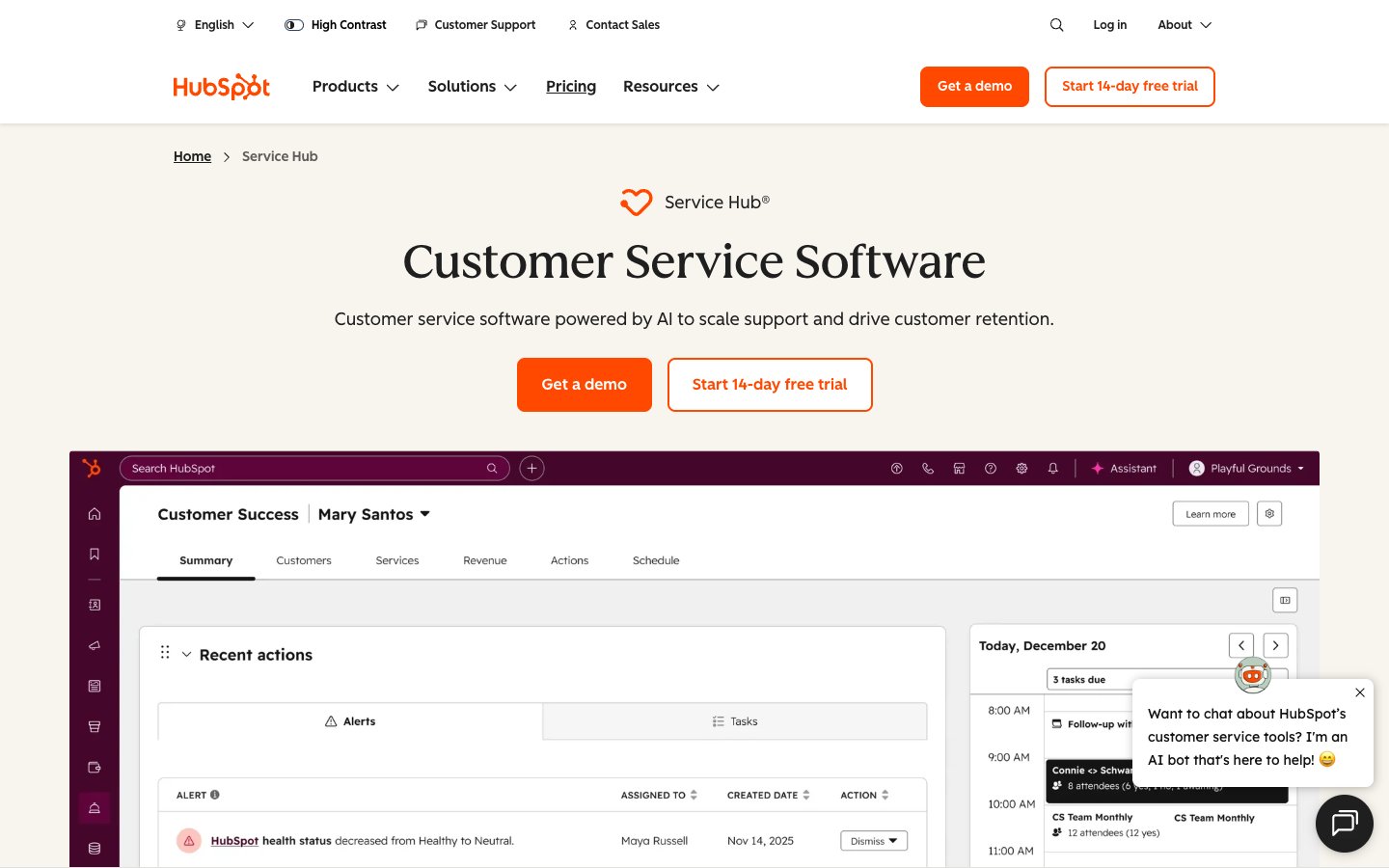
Overview: HubSpot Service Hub is a sales-first CRM platform that has expanded aggressively into customer service, combining its core sales and marketing CRM with help desk, ticketing, and customer feedback tools in a unified interface designed for mid-market contact centers that want CRM, service, and marketing automation without enterprise-level complexity.
Strengths: HubSpot Service Hub delivers one of the fastest time-to-value deployments in the CRM category, with an intuitive interface that reduces onboarding friction for sales and service teams. HubSpot Service Hub's native connection between marketing, sales, and service hubs means customer data flows across the entire buyer journey without requiring third-party middleware, and HubSpot's open API architecture provides straightforward data access for integration with adjacent contact center platforms.
Considerations: HubSpot Service Hub's service capabilities, while growing rapidly, don't match the depth of purpose-built service-first CRM platforms for high-volume contact center environments with complex routing, workforce management, and compliance requirements. HubSpot Service Hub's AI features are newer to market compared to established enterprise CRM competitors, and contact centers with advanced predictive analytics needs should evaluate the maturity of HubSpot's AI roadmap against current capabilities.
Best for: Mid-market contact centers and growing sales teams that need a CRM unifying sales, marketing, and service functions with fast deployment, an intuitive interface, and open data access, particularly when the contact center's primary CRM use case spans both inbound service and outbound sales.
| CRM Software Type | Description | HubSpot Service Hub |
|---|---|---|
| Full-Suite CRM | Manages sales, service, and marketing in one platform | |
| Service-First CRM | Built for support ticketing and case management | |
| Sales-First CRM | Optimized for pipeline and deal tracking | |
| Enterprise CRM | Multi-business-unit with ERP and back-office integration | |
| Industry-Specific CRM | Vertical-specific workflows and compliance | |
| AI-Native CRM | AI-powered analytics, routing, and automation at the core |
| CRM Software Feature | Feature Description | HubSpot Service Hub |
|---|---|---|
| Contact & Account Management | Unified customer profiles with interaction history | |
| Omnichannel Communication | Native voice, email, chat, SMS, and social engagement | |
| Sales Pipeline Management | Deal tracking, forecasting, and revenue analytics | |
| Customer Segmentation & Personas | Audience segmentation and persona-level targeting | |
| Workflow Automation | Automated routing, escalations, and task management | |
| Reporting & Analytics | Dashboards, custom reports, and KPI tracking | |
| AI & Predictive Intelligence | Predictive scoring, automated insights, and intelligent routing | |
| Sales Coaching & Enablement | Sales recordings, coaching workflows, and rep development | |
| Data Integration & API Openness | Open APIs and data portability to external platforms | |
| Compliance & Security | Access controls, audit trails, and regulatory compliance | |
| Customization & Extensibility | Custom objects, workflows, and app marketplace |
Zendesk CRM Software
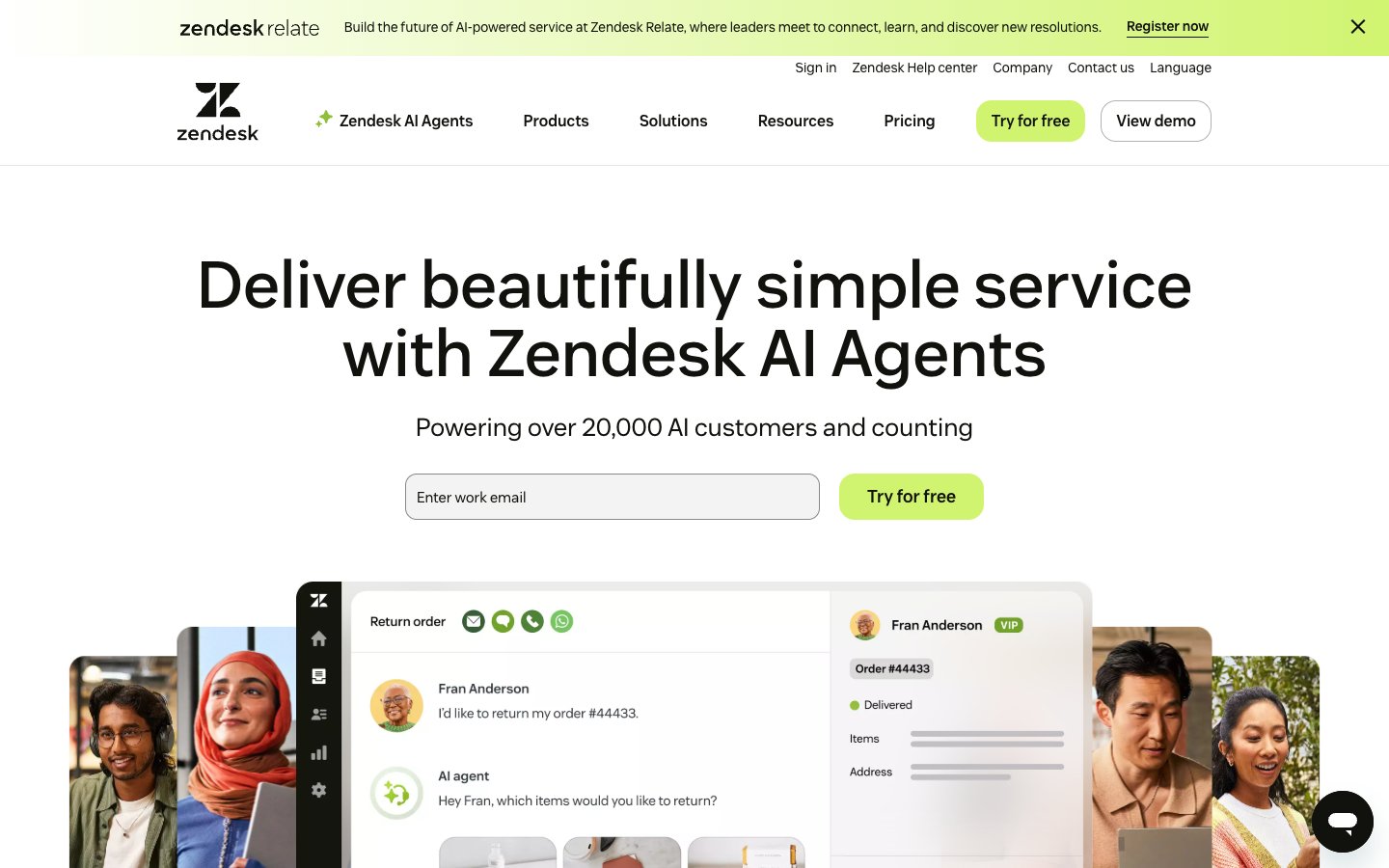
Overview: Zendesk is a service-first CRM platform built around customer support operations, delivering ticketing, help desk, live chat, and knowledge base capabilities with AI-powered automation through Zendesk AI agents that handle routine inquiries and route complex interactions to the right team.
Strengths: Zendesk provides one of the most focused service CRM experiences in the market, with a ticketing and case management architecture that handles high-volume support operations efficiently across email, chat, phone, social, and messaging channels. Zendesk's AI agents automate routine resolutions and triage, reducing manual workload for frontline teams, and Zendesk's marketplace offers hundreds of pre-built integrations that extend the platform into adjacent workflows without requiring custom development.
Considerations: Zendesk's CRM capabilities are anchored in service and support, and contact centers that need deep sales pipeline management, revenue forecasting, or marketing automation alongside their service CRM will find those capabilities lighter than full-suite or sales-first alternatives. Zendesk's data integration architecture provides API access and pre-built connectors, but contact centers with complex data portability requirements should evaluate how freely Zendesk data flows to external AI-native platforms for performance management, QA, and coaching use cases.
Best for: Contact centers where customer support and service operations are the primary CRM use case, particularly high-volume environments that need fast ticket resolution, AI-powered automation for routine inquiries, and a focused service platform that doesn't require managing the complexity of a full-suite CRM.
| CRM Software Type | Description | Zendesk |
|---|---|---|
| Full-Suite CRM | Manages sales, service, and marketing in one platform | |
| Service-First CRM | Built for support ticketing and case management | |
| Sales-First CRM | Optimized for pipeline and deal tracking | |
| Enterprise CRM | Multi-business-unit with ERP and back-office integration | |
| Industry-Specific CRM | Vertical-specific workflows and compliance | |
| AI-Native CRM | AI-powered analytics, routing, and automation at the core |
| CRM Software Feature | Feature Description | Zendesk |
|---|---|---|
| Contact & Account Management | Unified customer profiles with interaction history | |
| Omnichannel Communication | Native voice, email, chat, SMS, and social engagement | |
| Sales Pipeline Management | Deal tracking, forecasting, and revenue analytics | |
| Customer Segmentation & Personas | Audience segmentation and persona-level targeting | |
| Workflow Automation | Automated routing, escalations, and task management | |
| Reporting & Analytics | Dashboards, custom reports, and KPI tracking | |
| AI & Predictive Intelligence | Predictive scoring, automated insights, and intelligent routing | |
| Sales Coaching & Enablement | Sales recordings, coaching workflows, and rep development | |
| Data Integration & API Openness | Open APIs and data portability to external platforms | |
| Compliance & Security | Access controls, audit trails, and regulatory compliance | |
| Customization & Extensibility | Custom objects, workflows, and app marketplace |
Microsoft Dynamics 365 CRM Software
Overview: Microsoft Dynamics 365 is a full-suite enterprise CRM platform that combines sales, service, marketing, and field service capabilities with deep integration into the Microsoft ecosystem, including Teams, Outlook, Power BI, and Azure AI, delivering a CRM experience embedded directly into the productivity tools contact center teams already use daily.
Strengths: Microsoft Dynamics 365 provides native integration with Microsoft Teams for collaborative case management, Outlook for email-to-case workflows, and Power BI for custom reporting and analytics that pull CRM data alongside operational metrics from across the contact center. Microsoft Dynamics 365's Copilot AI delivers automated summaries, next-best-action recommendations, and predictive lead scoring within the CRM workflow, and Microsoft's Azure cloud infrastructure gives enterprise contact centers the scalability, compliance certifications, and data residency options required for regulated industries.
Considerations: Microsoft Dynamics 365 delivers the strongest ROI for contact centers already invested in the Microsoft ecosystem, and organizations running competing productivity suites or cloud platforms should evaluate whether the integration advantages justify the migration cost. Microsoft Dynamics 365's customization depth through Power Platform is powerful but adds implementation complexity, and contact centers should plan for longer deployment timelines and dedicated admin resources compared to lighter CRM alternatives.
Best for: Enterprise contact centers operating within the Microsoft ecosystem that need a CRM platform tightly integrated with Teams, Outlook, Power BI, and Azure, particularly organizations in regulated industries requiring enterprise-grade compliance, data residency controls, and scalable AI capabilities.
| CRM Software Type | Description | Microsoft Dynamics 365 |
|---|---|---|
| Full-Suite CRM | Manages sales, service, and marketing in one platform | |
| Service-First CRM | Built for support ticketing and case management | |
| Sales-First CRM | Optimized for pipeline and deal tracking | |
| Enterprise CRM | Multi-business-unit with ERP and back-office integration | |
| Industry-Specific CRM | Vertical-specific workflows and compliance | |
| AI-Native CRM | AI-powered analytics, routing, and automation at the core |
| CRM Software Feature | Feature Description | Microsoft Dynamics 365 |
|---|---|---|
| Contact & Account Management | Unified customer profiles with interaction history | |
| Omnichannel Communication | Native voice, email, chat, SMS, and social engagement | |
| Sales Pipeline Management | Deal tracking, forecasting, and revenue analytics | |
| Customer Segmentation & Personas | Audience segmentation and persona-level targeting | |
| Workflow Automation | Automated routing, escalations, and task management | |
| Reporting & Analytics | Dashboards, custom reports, and KPI tracking | |
| AI & Predictive Intelligence | Predictive scoring, automated insights, and intelligent routing | |
| Sales Coaching & Enablement | Sales recordings, coaching workflows, and rep development | |
| Data Integration & API Openness | Open APIs and data portability to external platforms | |
| Compliance & Security | Access controls, audit trails, and regulatory compliance | |
| Customization & Extensibility | Custom objects, workflows, and app marketplace |
Freshworks CRM Software
Overview: Freshworks delivers a service-first CRM platform through Freshdesk and Freshsales, combining customer support ticketing, sales pipeline management, and AI-powered automation through Freddy AI into a unified product suite designed for small to mid-market contact centers that need CRM functionality without enterprise-level pricing or implementation complexity.
Strengths: Freshworks provides a clean separation between its service CRM (Freshdesk) and sales CRM (Freshsales) that allows contact centers to deploy the specific capabilities they need without paying for modules they don't use, while the unified Freshworks platform connects both products through shared customer data when both are deployed. Freddy AI delivers automated ticket routing, canned response suggestions, and predictive contact scoring, and Freshworks' pricing structure makes advanced CRM capabilities accessible to contact centers operating with tighter budgets than enterprise-tier alternatives require.
Considerations: Freshworks' CRM capabilities are growing but don't match the customization depth or ecosystem breadth of enterprise platforms like Salesforce or Microsoft Dynamics 365, and contact centers with complex multi-department workflows or deep integration requirements should evaluate whether Freshworks' out-of-the-box capabilities meet their operational scale. Freshworks' AI features through Freddy are functional for mid-market use cases but newer to market compared to the AI maturity of larger CRM competitors, and contact centers with advanced predictive analytics requirements should benchmark Freddy's capabilities against their specific needs.
Best for: Small to mid-market contact centers that need a focused, affordable CRM platform with strong service ticketing and sales pipeline capabilities, fast deployment, and AI-powered automation without the implementation complexity or cost of enterprise-tier CRM platforms.
| CRM Software Type | Description | Freshworks |
|---|---|---|
| Full-Suite CRM | Manages sales, service, and marketing in one platform | |
| Service-First CRM | Built for support ticketing and case management | |
| Sales-First CRM | Optimized for pipeline and deal tracking | |
| Enterprise CRM | Multi-business-unit with ERP and back-office integration | |
| Industry-Specific CRM | Vertical-specific workflows and compliance | |
| AI-Native CRM | AI-powered analytics, routing, and automation at the core |
| CRM Software Feature | Feature Description | Freshworks |
|---|---|---|
| Contact & Account Management | Unified customer profiles with interaction history | |
| Omnichannel Communication | Native voice, email, chat, SMS, and social engagement | |
| Sales Pipeline Management | Deal tracking, forecasting, and revenue analytics | |
| Customer Segmentation & Personas | Audience segmentation and persona-level targeting | |
| Workflow Automation | Automated routing, escalations, and task management | |
| Reporting & Analytics | Dashboards, custom reports, and KPI tracking | |
| AI & Predictive Intelligence | Predictive scoring, automated insights, and intelligent routing | |
| Sales Coaching & Enablement | Sales recordings, coaching workflows, and rep development | |
| Data Integration & API Openness | Open APIs and data portability to external platforms | |
| Compliance & Security | Access controls, audit trails, and regulatory compliance | |
| Customization & Extensibility | Custom objects, workflows, and app marketplace |
Zoho CRM Software
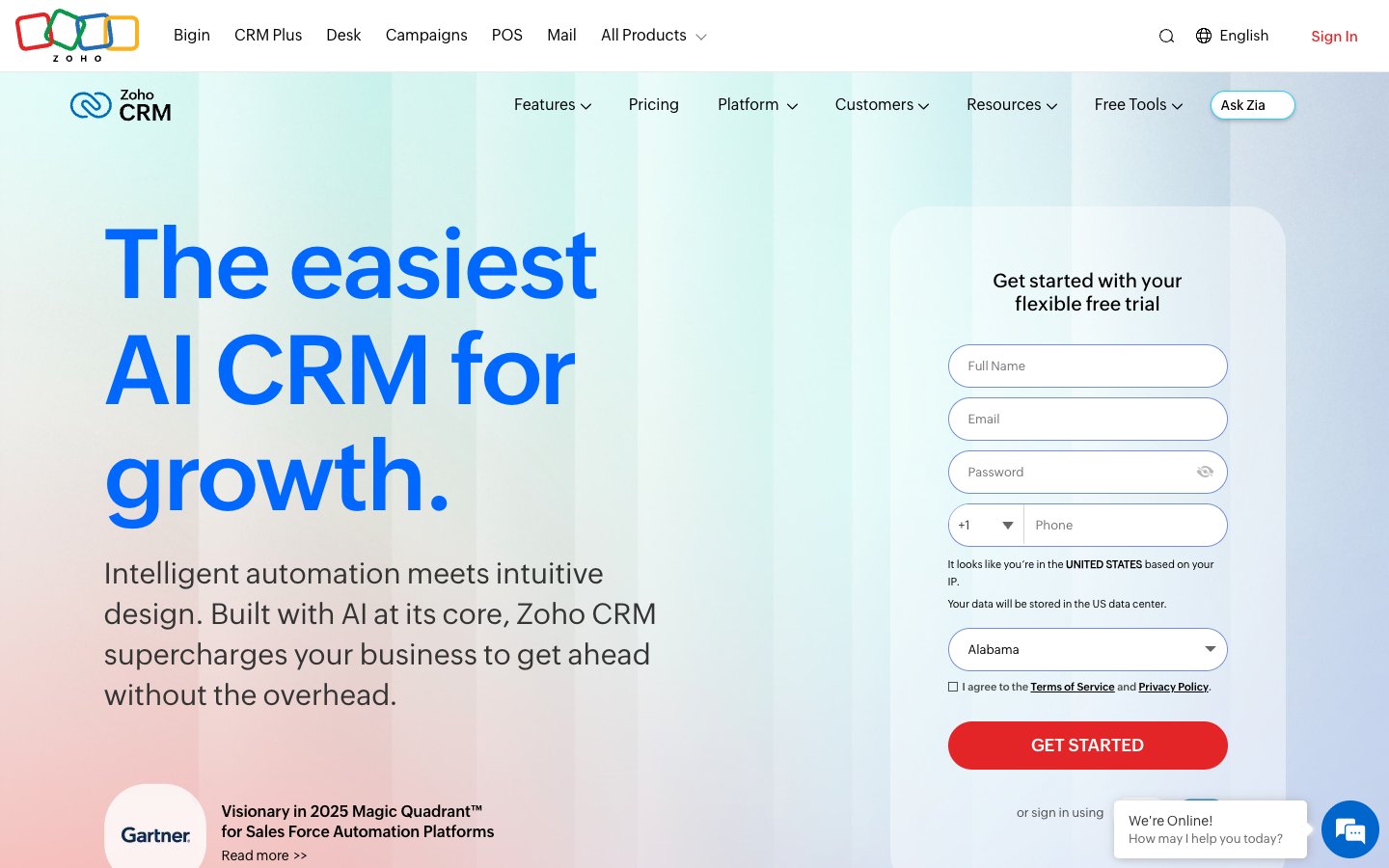
Overview: Zoho CRM is a full-suite CRM platform offering sales, service, and marketing automation through Zoho's broader ecosystem of 50+ business applications, delivering a comprehensive CRM experience with AI-powered analytics through Zia AI at a price point that makes full-suite CRM capabilities accessible to contact centers across small business, mid-market, and enterprise tiers.
Strengths: Zoho CRM provides one of the most cost-effective full-suite CRM deployments in the market, with sales pipeline management, customer support through Zoho Desk, marketing automation, and AI-powered lead scoring and forecasting available at pricing tiers significantly below enterprise competitors. Zoho CRM's ecosystem of native applications, including Zoho Desk, Zoho Analytics, Zoho Campaigns, and Zoho SalesIQ, creates a connected suite where customer data flows across sales, service, and marketing without requiring third-party integrations, and Zoho's open API architecture supports data portability to external platforms.
Considerations: Zoho CRM's breadth across 50+ applications means contact centers need to evaluate which Zoho products they actually need, because deploying the full ecosystem adds configuration complexity that offsets the platform's simplicity advantage for teams that only need core CRM functionality. Zoho CRM's AI capabilities through Zia are functional but less mature than the AI offerings from Salesforce Einstein or Microsoft Copilot, and enterprise contact centers with advanced predictive analytics or conversational intelligence requirements should evaluate Zia's current capabilities against their specific use cases.
Best for: Cost-conscious contact centers across small business and mid-market tiers that need a full-suite CRM spanning sales, service, and marketing without enterprise-level pricing, particularly organizations that benefit from Zoho's broader ecosystem of business applications and prefer a single vendor for multiple operational tools.
| CRM Software Type | Description | Zoho CRM |
|---|---|---|
| Full-Suite CRM | Manages sales, service, and marketing in one platform | |
| Service-First CRM | Built for support ticketing and case management | |
| Sales-First CRM | Optimized for pipeline and deal tracking | |
| Enterprise CRM | Multi-business-unit with ERP and back-office integration | |
| Industry-Specific CRM | Vertical-specific workflows and compliance | |
| AI-Native CRM | AI-powered analytics, routing, and automation at the core |
| CRM Software Feature | Feature Description | Zoho CRM |
|---|---|---|
| Contact & Account Management | Unified customer profiles with interaction history | |
| Omnichannel Communication | Native voice, email, chat, SMS, and social engagement | |
| Sales Pipeline Management | Deal tracking, forecasting, and revenue analytics | |
| Customer Segmentation & Personas | Audience segmentation and persona-level targeting | |
| Workflow Automation | Automated routing, escalations, and task management | |
| Reporting & Analytics | Dashboards, custom reports, and KPI tracking | |
| AI & Predictive Intelligence | Predictive scoring, automated insights, and intelligent routing | |
| Sales Coaching & Enablement | Sales recordings, coaching workflows, and rep development | |
| Data Integration & API Openness | Open APIs and data portability to external platforms | |
| Compliance & Security | Access controls, audit trails, and regulatory compliance | |
| Customization & Extensibility | Custom objects, workflows, and app marketplace |
Oracle CX CRM Software
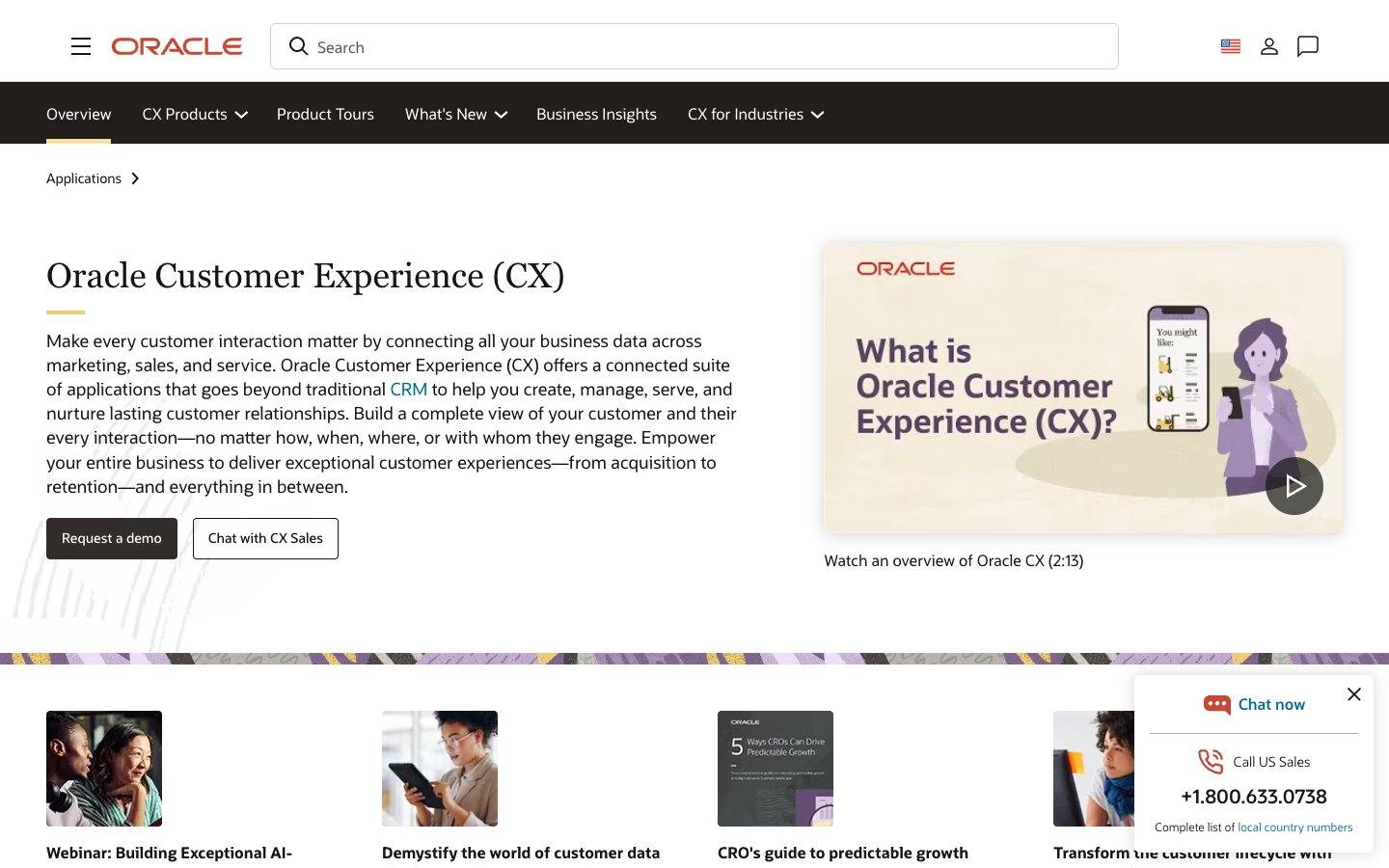
Overview: Oracle CX is an enterprise CRM platform that combines sales, service, and marketing automation with deep integration into Oracle's ERP, supply chain, and financial management infrastructure, delivering a CRM experience designed for large-scale contact center deployments where customer relationship data needs to connect directly to back-office operations, billing systems, and enterprise resource planning workflows.
Strengths: Oracle CX provides the deepest back-office integration of any CRM platform in this guide, connecting customer interaction data directly to Oracle ERP, Oracle Financials, and Oracle Supply Chain Management, giving enterprise contact centers a single data layer that spans front-office customer engagement through to fulfillment, billing, and revenue recognition. Oracle CX's AI capabilities through Oracle Adaptive Intelligence deliver predictive recommendations, automated lead scoring, and customer behavior modeling trained on the combined dataset of CRM interactions and transactional back-office data, providing intelligence that CRM-only platforms cannot generate.
Considerations: Oracle CX is purpose-built for Oracle ecosystem environments, and contact centers that don't run Oracle ERP or Oracle database infrastructure lose the primary integration advantage that justifies Oracle CX's deployment complexity and pricing. Oracle CX's implementation timelines and total cost of ownership reflect enterprise-scale deployments, and contact centers should plan for significant professional services investment during initial rollout and ongoing customization compared to lighter CRM alternatives.
Best for: Large enterprise contact centers already operating within the Oracle ecosystem that need a CRM platform deeply integrated with ERP, financial management, and supply chain infrastructure, particularly organizations where customer relationship data must flow bidirectionally between front-office engagement and back-office operations.
| CRM Software Type | Description | Oracle CX |
|---|---|---|
| Full-Suite CRM | Manages sales, service, and marketing in one platform | |
| Service-First CRM | Built for support ticketing and case management | |
| Sales-First CRM | Optimized for pipeline and deal tracking | |
| Enterprise CRM | Multi-business-unit with ERP and back-office integration | |
| Industry-Specific CRM | Vertical-specific workflows and compliance | |
| AI-Native CRM | AI-powered analytics, routing, and automation at the core |
| CRM Software Feature | Feature Description | Oracle CX |
|---|---|---|
| Contact & Account Management | Unified customer profiles with interaction history | |
| Omnichannel Communication | Native voice, email, chat, SMS, and social engagement | |
| Sales Pipeline Management | Deal tracking, forecasting, and revenue analytics | |
| Customer Segmentation & Personas | Audience segmentation and persona-level targeting | |
| Workflow Automation | Automated routing, escalations, and task management | |
| Reporting & Analytics | Dashboards, custom reports, and KPI tracking | |
| AI & Predictive Intelligence | Predictive scoring, automated insights, and intelligent routing | |
| Sales Coaching & Enablement | Sales recordings, coaching workflows, and rep development | |
| Data Integration & API Openness | Open APIs and data portability to external platforms | |
| Compliance & Security | Access controls, audit trails, and regulatory compliance | |
| Customization & Extensibility | Custom objects, workflows, and app marketplace |
SAP Service Cloud CRM Software
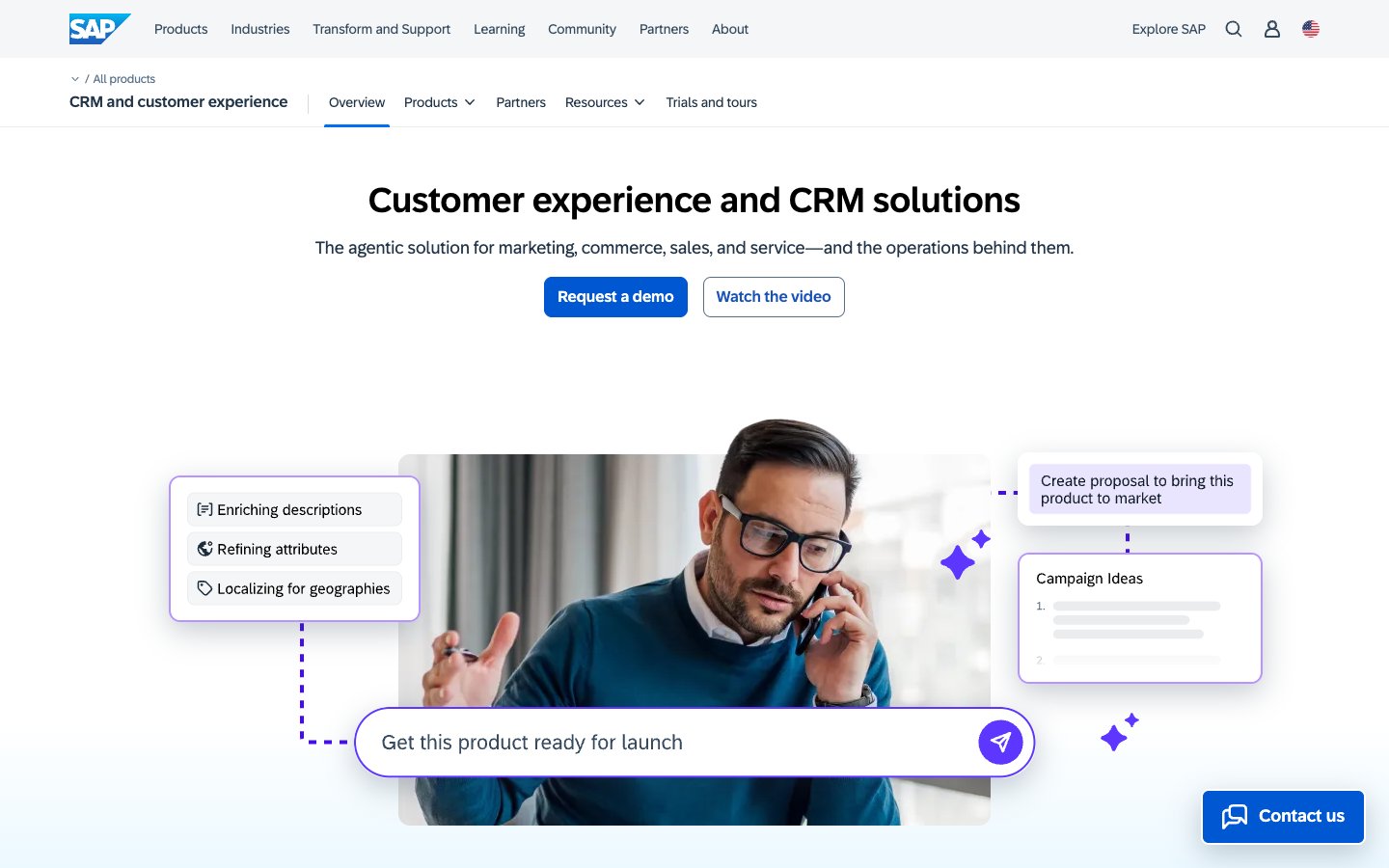
Overview: SAP Service Cloud is an enterprise CRM platform that delivers customer service, sales, and engagement capabilities tightly integrated with SAP's ERP, S/4HANA, and business technology platform, providing a CRM experience designed for global contact center operations where customer service data needs to connect directly to manufacturing, logistics, inventory, and financial systems.
Strengths: SAP Service Cloud provides native integration with SAP S/4HANA and SAP Business Technology Platform, connecting customer service interactions directly to real-time inventory data, order management, and supply chain visibility, giving service agents the ability to resolve complex customer inquiries that require back-office context without switching between disconnected platforms. SAP Service Cloud's global deployment capabilities support multi-language, multi-currency, and multi-entity contact center operations with data residency and compliance controls built for regulated industries across international markets.
Considerations: SAP Service Cloud delivers its strongest value in SAP ecosystem environments, and contact centers that don't run SAP ERP or S/4HANA infrastructure should evaluate whether SAP Service Cloud's enterprise integration advantages justify the deployment complexity and licensing cost compared to CRM platforms that operate independently of a specific back-office ecosystem. SAP Service Cloud's AI and automation capabilities are growing through SAP Business AI but are newer to market compared to the conversational AI maturity of CRM competitors like Salesforce and Microsoft, and contact centers with advanced AI requirements should benchmark current capabilities against their roadmap.
Best for: Global enterprise contact centers operating within the SAP ecosystem that need a CRM platform integrated with S/4HANA, supply chain management, and financial systems, particularly manufacturing, logistics, and industrial organizations where customer service resolution depends on real-time back-office data access.
| CRM Software Type | Description | SAP Service Cloud |
|---|---|---|
| Full-Suite CRM | Manages sales, service, and marketing in one platform | |
| Service-First CRM | Built for support ticketing and case management | |
| Sales-First CRM | Optimized for pipeline and deal tracking | |
| Enterprise CRM | Multi-business-unit with ERP and back-office integration | |
| Industry-Specific CRM | Vertical-specific workflows and compliance | |
| AI-Native CRM | AI-powered analytics, routing, and automation at the core |
| CRM Software Feature | Feature Description | SAP Service Cloud |
|---|---|---|
| Contact & Account Management | Unified customer profiles with interaction history | |
| Omnichannel Communication | Native voice, email, chat, SMS, and social engagement | |
| Sales Pipeline Management | Deal tracking, forecasting, and revenue analytics | |
| Customer Segmentation & Personas | Audience segmentation and persona-level targeting | |
| Workflow Automation | Automated routing, escalations, and task management | |
| Reporting & Analytics | Dashboards, custom reports, and KPI tracking | |
| AI & Predictive Intelligence | Predictive scoring, automated insights, and intelligent routing | |
| Sales Coaching & Enablement | Sales recordings, coaching workflows, and rep development | |
| Data Integration & API Openness | Open APIs and data portability to external platforms | |
| Compliance & Security | Access controls, audit trails, and regulatory compliance | |
| Customization & Extensibility | Custom objects, workflows, and app marketplace |
Call Center CRM Software Key Takeaways
-
Call center CRM software in 2026 spans six distinct types, from full-suite platforms managing sales, service, and marketing to focused service-first and sales-first CRM tools, and selecting the right type for your contact center prevents costly misalignment between what you buy and what your teams actually need.
-
Data portability and API openness matter more than feature parity, because the growing trend of CRM vendors gating data access to proprietary AI ecosystems and premium integration tiers restricts how freely your customer and sales insights reach the performance management, QA, and coaching platforms that need to act on them.
-
Sales coaching and enablement inside a CRM fragments your broader performance management process, disconnecting CRM-based coaching from QA evaluations, workforce data, and customer satisfaction metrics that together drive a complete view of agent development across the contact center.
-
Evaluate call center CRM software on total cost of ownership, including integration fees, API access tiers, implementation complexity, and the cost of workarounds needed to move CRM data to adjacent systems, not just the licensing price for the CRM itself.
Get More From Your Call Center CRM Software Data
Your CRM captures customer interactions, sales activity, and service outcomes across every channel, but that data only drives performance improvement when it reaches the teams and workflows that act on it. AmplifAI connects CRM data alongside QA evaluations, coaching workflows, and performance management into a unified platform that turns customer and sales insights into measurable agent development across your entire contact center.
Recommended Reading: Best Contact Center AI Software compares how AI-native platforms action CRM, QA, and performance data across the contact center.
Book a Demo to see how AmplifAI actions your CRM data alongside the rest of your contact center stack.
Key Takeaways
Call center CRM software in 2026 spans six distinct types, from full-suite platforms managing sales, service, and marketing to focused service-first and sales-first CRM tools, and selecting the right type for your contact center prevents costly misalignment between what you buy and what your teams actually need.
Data portability and API openness matter more than feature parity, because the growing trend of CRM vendors gating data access to proprietary AI ecosystems and premium integration tiers restricts how freely your customer and sales insights reach the performance management, QA, and coaching platforms that need to act on them.
Sales coaching and enablement inside a CRM fragments your broader performance management process, disconnecting CRM-based coaching from QA evaluations, workforce data, and customer satisfaction metrics that together drive a complete view of agent development across the contact center.
Evaluate call center CRM software on total cost of ownership, including integration fees, API access tiers, implementation complexity, and the cost of workarounds needed to move CRM data to adjacent systems, not just the licensing price for the CRM itself.