
How a Leading National Home Improvement Retailer Built Enterprise-Wide Performance Management Across Care, Sales, and BPO Partners
with Director, Operations Process & Strategy from Leading National Home Improvement Retailer and with Rico, Operations Supervisor from Leading National Home Improvement Retailer and with Jeffrie, Operations Supervisor from Leading National Home Improvement Retailer

Company
Leading National Home Improvement Retailer
Industry
Retail
Focus
Home Improvement & Big-Box Retail
Segment
Enterprise · Omnichannel Care & Sales · Internal + Multi-BPO Contact Centers
Products
Performance Enablement, Performance Management, AI-enabled Coaching, AutoQA, Customer Analytics, Data Integration
Integrations
Telephony / ACD, Workforce Management (WFM), CSAT / Voice of Customer Surveys, Sales / Order Management, BPO Reporting Systems
4%
Increase in agent productivity
20%
Increase in customer satisfaction
$135M
In incremental annual revenue
10,000+
Users across care, sales & BPO partners
Challenge
- Frontline care agents juggled deep product-knowledge demands across thousands of SKUs without timely, focused coaching — pulling CSAT down and creating preventable handle time.
- Supervisors burned 30–40% of every week pulling, aggregating, and emailing performance data from disconnected systems before they could coach anyone.
- By the time 1:1s happened, conversations turned into debate — agents were seeing their numbers for the first time and pushing back rather than improving.
- Scaling any of this enterprise-wide — across thousands of internal agents and outsourced BPO partners — required a single source of truth that the incumbent CX infrastructure platform couldn't deliver.
Solution
- AmplifAI replaced the manual data-pull-and-email cycle with daily, agent-self-serve performance data, including verbatim customer feedback inside the same pane of glass.
- Supervisors got data-backed next-best-action coaching prompts that focused 1:1 time on the biggest improvement opportunity — preparation went from hours to minutes.
- Coverage expanded program by program: from an 80-agent care pilot, to the full customer care organization, to an inside sales team, to enterprise-wide deployment across internal teams and BPO partners.
- Auto QA and Customer Analytics layered on top — automating quality scoring and turning every customer conversation into a data signal that feeds performance management.
Results
- Customer care delivered a 4% gain in agent productivity and a 20% increase in CSAT within the first 10 weeks of the pilot.
- An inside sales team unlocked $135M in incremental annual revenue — driven by a 27% lift in conversion rate and a 31% gain in active selling hours per year.
- Supervisor coaching prep dropped roughly 60%, and coaching conversations shifted from contentious to collaborative as agents owned their own data daily.
- What started as a single pilot became the enterprise-wide performance management layer for 10,000+ users across customer care, sales, and outsourced BPO partners — independently validated by an industry-leading analyst.
TL;DR
How a leading national home improvement retailer scaled AmplifAI from an 80-agent care pilot into the enterprise-wide performance management layer for 10,000+ users — including outsourced BPO partners — and is now extending the same system to power Auto QA and Customer Analytics across sales and service operations.
The Opportunity
A leading national home improvement retailer runs one of the largest omnichannel customer operations in retail — millions of conversations a year about products that range from a single replacement bolt to a multi-room remodel. Customers expect agents to know the catalog the way an in-store associate knows their own aisle. That bar is hard to clear on a single product line. Across thousands of SKUs, across hundreds of suppliers, across both internal teams and outsourced partners, it had become structurally impossible.
The operations leadership team had two interlocking problems. The first was a customer one: handle time was outpacing the line of business, but customer satisfaction (CSAT) was not where it needed to be. Customers wanted expertise — and they wanted it fast. The second was a frontline one. Supervisors were drowning in spreadsheets. By the time a coaching conversation happened, the agent was hearing about a problem that had been live for a week, and the supervisor was reading data out of a report instead of teaching a behavior.
The team set out to do two things at once: improve the customer experience on every call, and rebuild the operating model that supervisors used to actually develop their agents. The path to one ran through the other.
Choosing a Performance Management Platform Built for the Frontline
The selection process pitted AmplifAI against the incumbent — a large CX infrastructure player already embedded in the retailer's stack. On paper, staying with the incumbent was the easier story. In practice, the incumbent had been built for the back office: dashboards for managers, reports for QBRs, integrations for IT. It had not been built for the seven minutes a supervisor and an agent actually spend together in a 1:1.
AmplifAI's positioning was the opposite. The platform was designed to put performance data directly in the hands of the people who shape outcomes — the frontline agent and their direct supervisor — and to take everything that prevented coaching from happening (data wrangling, system swiveling, contentious conversations) off the table.
The retailer's call center performance management decision came down to a simple test: which platform makes the next coaching session better? They chose AmplifAI.
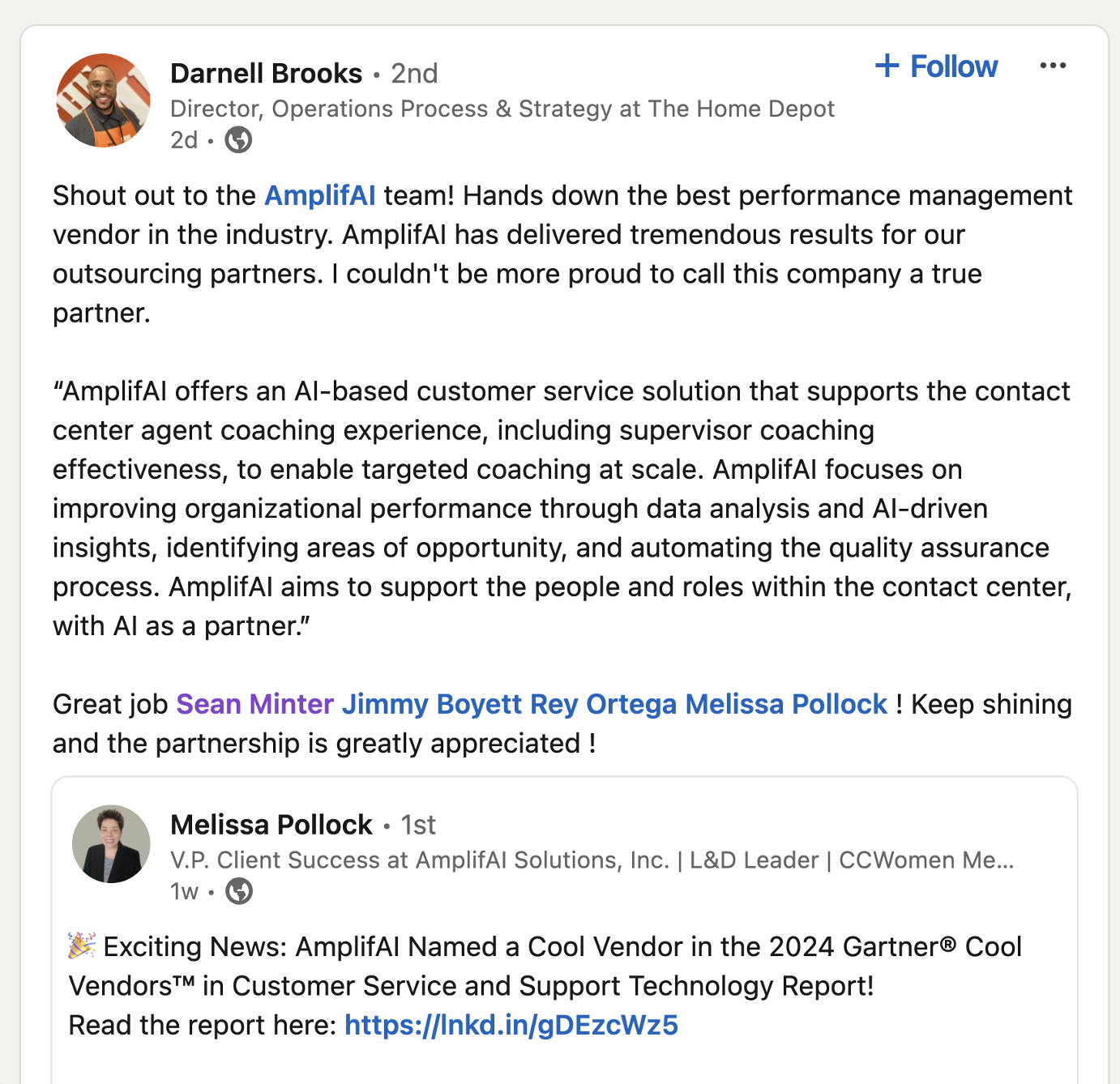
“Hands down the best performance management vendor in the industry. AmplifAI has delivered tremendous results for our outsourcing partners. I couldn't be more proud to call this company a true partner.”
Director, Operations Process & Strategy
Leading National Home Improvement Retailer
The 80-Agent Pilot: Daily Data Replaces Weekly Reports
The first deployment was deliberately small: 80 agents inside a single customer care group. The headline change was unglamorous and enormous. Performance data refreshed daily instead of weekly, and every agent could see their own numbers the same day the customer experience produced them — including, for the first time, the verbatim text from customer surveys about their service.
Three things shifted at once:
- Agents owned their own data. They no longer waited for a 1:1 to see what their week looked like. By Friday morning they had already self-corrected what Friday afternoon's coaching would have flagged.
- Supervisors stopped manufacturing reports. Previously, 30–40% of a supervisor's week disappeared into pulling, aggregating, and emailing performance data across multiple systems. With one source of truth, that workload collapsed.
- Coaching conversations changed shape. Before, agents arrived at 1:1s seeing their numbers for the first time — and pushed back. After, they walked in already knowing what the data said, and the conversation started where it should: on the behavior, not the scoreboard.
The retailer's culture is famously employee-centric. Their leadership team described the shift in supervisor-agent dynamics as one of the most visible cultural effects of the rollout — coaching meetings became easier, nicer, and more effective, because the data had stopped being a surprise.
Where the 4% Productivity and 20% CSAT Lift Came From
The retailer measured the pilot the way it measures everything: a controlled before-and-after across two equal windows. Ten weeks of operating data before AmplifAI launched, against ten weeks of operating data after agents and supervisors were live on the platform.
The two KPIs that mattered to the care team were average handle time and the rate of CSAT survey responses landing at the top of the scale. Both moved.
- Agent productivity, measured through AHT against the group's baseline, improved 4%.
- The CSAT survey rate — the share of customer interactions that produced a top-box satisfaction score — climbed 20%.
Those numbers were not the result of any one initiative. They were the cumulative effect of giving agents real-time visibility into their own performance and freeing supervisors to spend coaching time on the behavior that needed it, every week, every agent. The pilot produced enough proof for the team to do the obvious next thing: extend the same engine into a completely different program.
“AmplifAI is one of the greatest tools ever. It reduces the amount of time I spend deep diving and reviewing trends and puts it all in one report. By the time our 1:1 is up, agents are well aware of trends and can critically think on behaviors to improve.”
Rico
Operations Supervisor
Extending the Same Engine Into Sales: $135M in Incremental Revenue
After the care pilot proved out, the retailer brought AmplifAI into an inside sales team — one of several specialized sales groups that sit alongside the core service organization. The objective changed from satisfaction to revenue, but the operating model did not. Daily data. Supervisor coaching focused on the next-best behavior. Agents owning their own numbers.
The analysis window was a single quarter — the first full quarter the sales team operated on AmplifAI after their ramp. The team comparing baseline to AmplifAI was 112 sellers at the start of the quarter and 114 at the end, so headcount was not the lever. The lever was what those sellers did with their time.
| Metric | Change |
|---|---|
| Sales conversion rate | +27% |
| Active selling hours per year | +31% |
| Dollar value per sale | +7% |
Conversion went up. Productive time went up. The economics of each conversion went up. Carried forward across the quarter at the team's new run-rate, the lift represented $135 million in incremental annual revenue from a single sales team — a comparison anchored against the same team's pre-AmplifAI baseline.
What made the result transferable, not just impressive, was that the operating model was the same one the care team had been running for months. The retailer had not bought two products. They had bought one coaching and performance management system and pointed it at a second program.
From Pilot to Platform: Scaling Across 10,000+ Users and BPO Partners
What started as 80 agents grew steadily. Customer care. Specialized sales. Then the rest of the retailer's contact center footprint — and, critically, the outsourced BPO partners handling overflow and program-specific work. Today, AmplifAI is the performance management layer for more than 10,000 users across the retailer's internal and outsourced contact center population.
Bringing BPO partners onto the same platform mattered for two reasons. First, the retailer's brand experience is the same whether a customer reaches an internal agent or a partner-staffed one — so the operating model that drives quality had to be the same. Second, performance conversations with BPO partners had historically been about reports and SLAs. With AmplifAI, those conversations became about agents and behaviors. The partner relationship became operationally identical to the internal team's: same data refresh cadence, same coaching prompts, same accountability model.
The retailer's director of operations process and strategy summarized the position publicly:
The frontline experience tracked the leadership view — supervisors on the platform for the long stretch of the rollout described the same shift in coaching dynamics, with agents arriving at 1:1s already aware of their own trends and ready to talk about behaviors rather than scores.
“AmplifAI has allowed the associates to be in control of their own data. By the time we meet and talk, it's a stress-free conversation in finding ways to overcome opportunities.”
Jeffrie
Operations Supervisor
Independently Validated by an Industry-Leading Analyst
An industry-leading analyst firm — covering customer service and support technology — published independent research on the program. Their report described the same three operating principles the retailer had been running on for years:
- Performance transparency. On-demand access to performance data encourages accountability and accelerates communication around improvement areas.
- Supervisor next-best-action. Data-backed coaching suggestions help supervisors recognize improvements and follow up on missed opportunities — making limited coaching time count.
- Isolating supervisor impact from team baseline. Measuring the percent of coaching sessions that lead to agent improvement separates supervisor performance from raw team performance — and tells managers exactly which supervisors need development themselves.
The same research validated three prerequisites that the retailer had committed to from the first 80-agent pilot: data must refresh frequently enough to match the coaching cadence; it must be consolidated and pushed to the supervisor (not pulled from five systems); and it must be visible to the agent before the coaching session, not during it.
The published outcomes the analyst documented from this program:
| Outcome | Result |
|---|---|
| Customer satisfaction (CSAT) | +3 points on phones · +1 point on messaging |
| Average handle time (AHT) | -8% reduction |
| Supervisor coaching prep time | -60% reduction in per-session prep |
| Agent and supervisor satisfaction | Automated guidance improved interaction quality and feelings of belonging |
The independent finding mattered more than any vendor-published number could. The retailer's program was not an internal anecdote anymore — it was an analyst-verified pattern other operations leaders could study and apply.
The Next Chapter: Auto QA and Customer Analytics
The performance management layer was the foundation. The retailer is now extending the same platform into two newer capabilities — Auto QA and customer analytics — that work with, not around, the operating model they've spent years building.
Auto QA automates the quality scoring of every conversation, not just the small statistical sample a manual QA team can grade. That changes two things at once. It makes coaching even more focused — supervisors see quality patterns across every customer interaction, not the four-or-five sampled ones. And it gives the agent total transparency: every call is reviewable, every behavior is visible, every coaching opportunity is grounded in a real conversation.
Customer analytics layers what customers are actually saying — verbatim, at scale — onto the same agent and supervisor dashboards. The signals that used to live in survey verbatims (originally surfaced in the first pilot) now extend across the full conversation set: emerging themes, root-cause categories, sentiment shifts that no longer wait for a weekly report.
What the retailer is building, at this point, isn't a coaching tool layered on a contact center. It's a single performance, quality, and customer insight platform — same data, same agents, same supervisors, same operating model — extended across every conversation, every program, every partner.
The journey is the playbook. Start with a focused pilot that fixes the coaching loop. Prove it on one program. Extend to the next. Bring the partners onto the same operating model. Then layer in the next generation of capability — quality automation, customer analytics — on top of the foundation. That sequence is how a 80-agent care pilot becomes the retail customer experience operating system for 10,000+ users across an entire enterprise.
Key Takeaways
Performance management succeeds when the data lands in the hands of the agent and the direct supervisor — not when it reaches the executive dashboard.
Daily refresh beats weekly reports because the coaching cadence has to match the data cadence; coaching to last week's number teaches yesterday's behavior.
Eliminating 30–40% of the supervisor's week spent compiling reports is not a productivity win — it is a coaching capacity win that compounds across the team.
The same operating model that improves CSAT in service improves conversion in sales. Performance management transfers across programs because the human levers are the same.
Bringing BPO partners onto the same platform turns vendor management from an SLA conversation into an agent-development conversation — and equalizes the brand experience.
Pilots scale into platforms when each successive program inherits the operating model rather than rebuilding it. The retailer started with 80 agents and ended up running an enterprise on one system.